Alpine apk passthrough
How yoe consumes prebuilt Alpine packages through module-alpine, and the sharp
edges around metadata, noarch routing, and -dev subpackages. Read this before
adding a new feed, debugging a “no such package” install error, or expanding the
Alpine surface beyond module-core’s source-built userland.
See Catalog and Materialization for the resolver-side mechanics
that back the passthrough path — how alpine_feed registers a synthetic module,
when units actually materialize, and what the working set looks like. This page
focuses on what passes through and why.
Why this exists
Yoe started by treating every package as something it builds from source — each
unit produced a $DESTDIR of files and internal/artifact/apk.go packaged that
destdir into a fresh .apk with a yoe-generated PKGINFO and a project-key
signature. For module-alpine units (which fetch a prebuilt Alpine apk), the
same path applied: extract Alpine’s apk into $DESTDIR, then rebuild a
yoe-flavoured apk on top.
That works as long as Alpine’s PKGINFO is just a list of names — but Alpine’s
apks carry a lot more:
replaces = busyboxso two packages can both ship a path without apk failing the install.provides = so:libcrypto.so.3=3.5.4-r0so packages that link against a shared library find their dep cleanly.provides = cmd:sh=1.37.0-r14so file-deps like/bin/shresolve.triggers = /usr/lib/firmware*so kernel module updates re-fire hot-plug helpers..pre-install/.post-install/.triggershell scripts that run at install-time inside a chroot of the rootfs.
Regenerating PKGINFO from a hand-written .star drops every field the
generator didn’t enumerate. Most visibly: busybox’s .post-install is where
applet symlinks (/bin/sh, /sbin/init, …) get created via
/bin/busybox --install -s. Without it the kernel boots and finds no working
init.
The current architecture — passthrough — sidesteps all of this by publishing Alpine’s apk verbatim, only swapping the signature.
Passthrough, in two pieces
1. alpine_feed materializes synthetic units lazily
module-alpine/MODULE.star is two alpine_feed(...) calls — one per Alpine
repo section (main, community) — and a small units/*-enable.star companion
layer for service enablement. No per-package .star files; the ~3,700-entry
Alpine main catalog is checked in as one decompressed APKINDEX text file per
arch.
# module-alpine/MODULE.star (production shape)
alpine_feed(
    name    = "main",
    url     = "https://dl-cdn.alpinelinux.org/alpine",
    branch  = "v3.21",
    section = "main",
    index   = "feeds/main",                            # in-tree APKINDEX dir
    keys    = ["keys/alpine-devel@lists.alpinelinux.org-6165ee59.rsa.pub"],
)
Each alpine_feed call registers a SyntheticModule named
<parent>.<feed-name> (alpine.main, alpine.community). The resolver
materializes a *Unit on demand the first time a closure walk references the
package name — see
Catalog and Materialization for the cache +
lookup flow. The materialized unit carries
PassthroughAPK = "<pkgname>-<pkgver>.apk" and an install task constructed
from the upstream APKINDEX entry.
The companion layer is small and hand-written. Today: units/docker-enable.star
and units/navidrome-enable.star — units with no build steps that declare
services = ["docker"] / ["navidrome"] so the runlevel symlink lands in the
package’s data tar. See the “package-driven service enablement” decision in
CLAUDE.md for why service enablement is its own unit rather than
a flag on the feed.
2. The executor calls RepackAPK instead of CreateAPK
internal/build/executor.go branches on unit.PassthroughAPK:
- Empty →
artifact.CreateAPK(destDir, ...)— the original “build a fresh apk” path. Source-builtmodule-coreunits take this path. - Set →
artifact.RepackAPK(srcAPK, ...)— splits Alpine’s apk into its three concatenated gzip streams, drops the Alpine signature, re-signs the control stream (PKGINFO + install scripts) with the project key, and concatenates[new_sig, control, data]into the published apk.
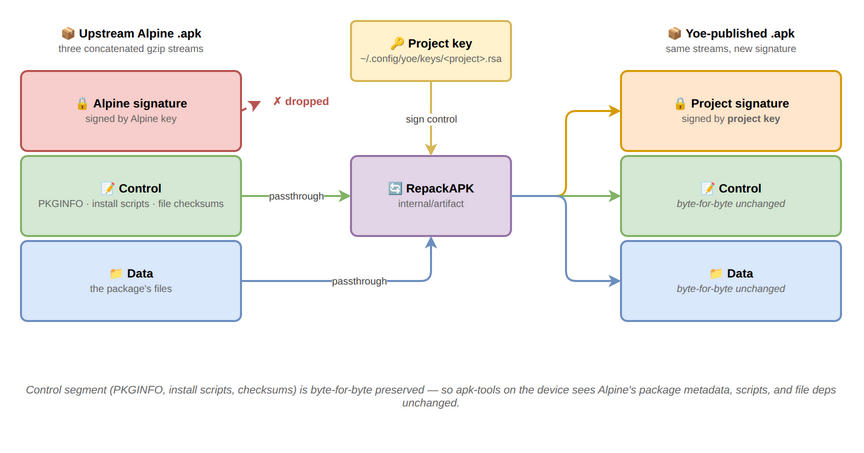
RepackAPK does not rewrite anything inside the control or data segments.
Alpine’s PKGINFO, replaces, provides, triggers, install scripts, file
checksums — all unchanged.
The destdir extraction (the materialized unit’s install task) is still useful:
yoe’s per-unit sysroots are built by hardlinking each dep’s destdir into
<unit>/sysroot/, so a unit that gcc -lfoos against a module-alpine library
finds headers and shared objects there. Image-time apk add reads the published
apk (passthrough) and never looks at the destdir.
Legacy: alpine_pkg class
classes/alpine_pkg.star is still in the module but no production unit uses it.
It was the pre-feed entry point — one hand-written .star file per package,
calling alpine_pkg(...) with hashes baked in. The class is preserved for
one-off external uses (a downstream module that wants to wrap a single upstream
apk without standing up a whole feed); for the in-tree module-alpine, feeds
replaced it. If you’re tempted to add a per-package .star calling
alpine_pkg, ask first whether the feed should have the package already —
adding a hand-written wrapper for a name the feed already exposes will produce a
conflicting registration.
Two metadata systems, two purposes
After passthrough, every unit has metadata in two places:
- The materialized
*Unit(Name,Version,RuntimeDeps,Provides,Replaces,Distro, …) drives yoe’s resolver: build-order DAG, runtime-closure walk for image artifacts, virtual-package routing (linux→linux-rpi4), TUI USED-BY/PULLS-IN trees, the per-image distro visibility filter (an alpine image’s closure doesn’t see debian-tagged units and vice versa). For feed-materialized units this view is constructed from the APKINDEX entry at lookup time (apkindex.MaterializeUnitininternal/apkindex/); for source-built and companion units, it’s whatever the.starfile declared. - Upstream
PKGINFO(inside the apk’s control segment) drives apk-tools at install time on the target: real shared-library deps, file-dep resolution, install-script execution, conflict checking.
These overlap conceptually but serve different stages. yoe’s resolver doesn’t
see so:libcrypto.so.3 because it’s not in the materialized unit’s
runtime_deps; apk-tools doesn’t see yoe’s virtual linux because that’s a yoe
concept, not an apk one.
The materialized unit therefore should mirror enough of upstream’s metadata
that yoe’s resolver makes the same decisions apk-tools would — without
duplicating every field. For feed-materialized units this happens at lookup
time: MaterializeUnit reads the APKINDEX entry’s dep list, runs each token
through the project-wide provides table (cross-feed siblings included via
multiFeedProviders), and produces a *Unit whose RuntimeDeps name yoe units
rather than apk virtuals. Hand-written companion units like docker-enable set
yoe-specific overrides (services = ["docker"]) that the feed couldn’t infer
from APKINDEX alone.
noarch routing — the four-part fix
apk-tools is unforgiving here: it constructs fetch URLs from PKGINFO’s arch
field, not from where it found the index entry. So a noarch apk has to
physically live at <repo>/noarch/<file> — putting it under <repo>/<arch>/
and listing it in <arch>/APKINDEX doesn’t make apk look there. Conversely,
apk’s solver only reads one arch’s APKINDEX per repository invocation, so noarch
entries also have to appear in the per-arch index.
The full design now in tree:
executor.goroutes noarch passthrough apks to<repo>/noarch/. The arch comes from upstream PKGINFO viaartifact.ReadAPKArch, not from the build arch.GenerateIndexscans the sibling<repo>/noarch/tree when building a per-arch index, so each arch’s APKINDEX advertises every noarch package asA:noarch. apk’s solver finds the entry from any per-arch index.Publishregenerates every per-arch APKINDEX after a noarch publish. Without this, the per-arch indexes go stale on every noarch unit rebuild.cacheValidlooks under<repo>/noarch/when the apk isn’t in the per-arch dir, so noarch passthrough units don’t rebuild on everyyoe buildinvocation.
Symptoms when one of these halves is missing:
package mentioned in index not found— usually file in arch dir but PKGINFO says noarch (apk fetches from<base>/noarch/, 404s).<name> (no such package): required by world[<name>]— file in noarch dir but per-arch APKINDEX doesn’t reference it.- noarch unit shows
[building]every run despite the published apk being unchanged —cacheValidwas checking the wrong directory.
Auto-emitted so: provides
For yoe-source-built units, internal/artifact/apk.go walks $DESTDIR, opens
every regular file with Go’s debug/elf, reads DT_SONAME, and emits one
provides = so:<soname>=<ver>-r<rel> line per shared library. This matches
Alpine’s abuild convention and lets Alpine prebuilts that declare
depend = so:libcrypto.so.3 resolve cleanly against a yoe-built openssl.
The mirror — auto-emit depend = so:<soname> from DT_NEEDED — is on the
roadmap (see docs/roadmap.md’s “Auto-depend from ELF DT_NEEDED”).
Auto-versioned provides
Explicit virtuals listed in a unit’s provides = [...] field are also stamped
with =<ver>-r<rel> on emit. So:
unit(name = "openssl", version = "3.4.1", provides = ["libssl3", "libcrypto3"])
emits provides = libssl3=3.4.1-r0 and provides = libcrypto3=3.4.1-r0 in the
package’s PKGINFO. Without the version, apk treats the provide as unversioned
and refuses to use it to satisfy consumer constraints like
depend = libssl3>=3.3.0 (which is what Alpine’s prebuilt python3 ships). If
the entry already carries a constraint (=, <, >, ~), it’s emitted
verbatim — useful when a unit needs to claim a specific older version’s API
contract.
Worked example: why we couldn’t use Alpine’s docker-openrc
Tested end-to-end during the OpenRC switch. Documenting because the same shape
of problem will recur with any Alpine package whose dep tree pokes deep enough
into module-core’s source-built userland.
The goal: wire dockerd into the OpenRC default runlevel using Alpine’s
docker-openrc package (which ships /etc/init.d/docker and a
/etc/conf.d/docker config template Alpine maintains).
The dep tree (drawn out from upstream PKGINFOs):
docker-openrc
└── log_proxy
    ├── musl
    └── glib
        ├── pcre2
        ├── libffi
        ├── libintl
        └── libmount
            └── libblkid
log_proxy is a tiny Alpine utility for capturing daemon stdout/stderr to
syslog. Glib is needed because log_proxy uses GIO. libmount/libblkid are in
glib’s transitive deps because GIO has mount-table integration.
The conflict. Yoe’s source-built util-linux (in module-core) ships
libmount.so.1 and libblkid.so.1 directly — it’s a monolithic build. Alpine
splits util-linux: libmount and libblkid are separate apks. When apk’s
solver tries to install both yoe’s util-linux and Alpine’s libmount/libblkid, it
fails because both packages own the same library paths.
First attempt: prefer_modules = {"alpine": {"util-linux": "alpine.main"}}.
Forces the Alpine prebuilt instead of yoe’s source-built version (pin syntax
names the synthetic module, not the parent — alpine.main rather than
alpine). Resolves the library conflict. But Alpine’s util-linux apk is a
meta package — it ships nothing on disk; the actual binaries live in
util-linux-misc, util-linux-login, the libraries in
libuuid/libmount/libblkid, and the headers + unversioned .so symlinks
needed at compile time live in util-linux-dev.
After pulling subpackages in via runtime_deps, the next layer: e2fsprogs
(yoe-source-built) needs libuuid headers + the unversioned libuuid.so
symlink to compile. Those live in util-linux-dev. Adding that pulls
libfdisk, liblastlog2, libsmartcols, sqlite-dev — none of which have yoe
units. Each one in turn pulls more.
The yak shave. To fully consume Alpine’s util-linux-dev, we’d need units
for at least a dozen Alpine subpackages, plus their -dev counterparts, plus
careful conflict bookkeeping where yoe-source-built packages still ship
competing files. That’s days of work and a much larger Alpine surface to
maintain.
The trade. A 30-line yoe-side OpenRC service script (in
modules/module-core/units/net/docker-init/) gives us the same boot behaviour
with no transitive deps. We give up Alpine’s /etc/conf.d/docker config
template and the log_proxy stdout-capture story; for a yoe image those costs are
minor.
The lesson generalizes: Alpine’s -dev subpackage convention is fundamentally
at odds with yoe’s monolithic source-built libraries. Picking off Alpine
packages one at a time is fine; widening the surface to consume Alpine’s whole
library-development ecosystem is a significant architecture decision, not a
one-off fix.
What’s still rough
Items where the architecture is “works for now” but obviously incomplete.
-
No support for
-devpackages. All the architectural reasons in the docker-openrc example. Until yoe has a story for splitting headers out of source-built libraries (or for systematically wrapping Alpine’s-devecosystem), pulling new Alpine packages in is a manual review for “does this transitively need any -dev subpackage.” -
No
triggersexecution. Alpine apks ship.triggerscripts that fire on path changes (e.g.udevre-runs hot-plug rules when a module is added). The passthrough copy includes them, but yoe’s image assembly doesn’t currently invoke them in any consistent way. apk’s on-target trigger machinery handles them after first boot, but image-build-time triggers (-tin apk) don’t happen. -
Auto-depend from
DT_NEEDED. Counterpart to the auto-so:-provides scan that already runs. Would catch the class of bug where a unit’s RuntimeDeps silently misses a transitive shared-lib dependency. Roadmap item; design indocs/roadmap.md. -
prefer_moduleswith subpackage expansion. When you push a monolithic source-built unit (util-linux) to Alpine’s split form, yoe’s resolver followsruntime_depsfrom the meta package — but build-time deps (unit.Deps) onutil-linuxdon’t pull subpackage destdirs into the build sysroot. Workaround: declare downstream units’ build deps on the subpackages directly. Long-term the resolver should walk runtime_deps for build-deps too, orunit.Depsshould accept the same expansion. -
RepackAPKre-sign vs upstream-keys passthrough. The current path strips Alpine’s signature and re-signs with the project key. An alternate design — keep Alpine’s keys + signature, ship Alpine’s keyring on-target as an additional trust anchor — is captured in docs/specs/2026-05-18-mirror-alpine-keep-keys.md (spec only, not implemented). The trade-off: re-signing means the on-target trust list stays “one key per project” but every passthrough requires cryptographic work; keeping upstream keys removes the re-sign cost but multiplies on-target trust anchors (one per distro the project consumes from). No decision yet on which way to land.
Reference
internal/artifact/apk.go—CreateAPK,RepackAPK,ReadAPKArch,scanSONAMEs.internal/feeds/alpine/builtin.go—alpine_feedbuiltin,SyntheticModuleregistration,populateBuildFields(setsPassthroughAPK,SourceURL,Distro = "alpine", install task with control-file exclusions). The pre-feed wrapper class lives attestdata/.../module-alpine/classes/alpine_pkg.starfor legacy / external one-off use.internal/apkindex/materialize.go—MaterializeUnit: APKINDEX entry →*Unit. WrapsmultiFeedProvidersfor cross-feed dep resolution.internal/build/executor.go— passthrough branch in the build loop;cacheValidfor the noarch lookup.internal/repo/local.go—Publish(with cross-arch reindex on noarch) andindex.go’sGenerateIndex(sibling-noarch scan).internal/feeds/alpine/update.go—yoe update-feedsdriver: fetches upstream APKINDEX, verifies RSA-SHA1 against declared keys, atomically writes to the in-tree feed index.docs/catalog.md— resolver-side mechanics (synthetic modules, lazy materialization, working-set sizes, invariants).docs/module-alpine.md— when to reach formodule-alpinevsmodule-core(rubric, not architecture); maintainer playbook foryoe update-feeds.