Build Dependencies and Caching
Traditional embedded build systems maintain a sharp boundary between “building the OS” and “developing applications.” The OS team produces an SDK — a frozen snapshot of the sysroot, toolchain, and headers — and hands it to application developers. From that point on, the two worlds drift: the SDK ages, libraries diverge, and “it works on my machine” becomes “it works with my SDK version.”
[yoe] eliminates this boundary by recognizing that there are distinct kinds of
build dependencies, and they should be managed differently:
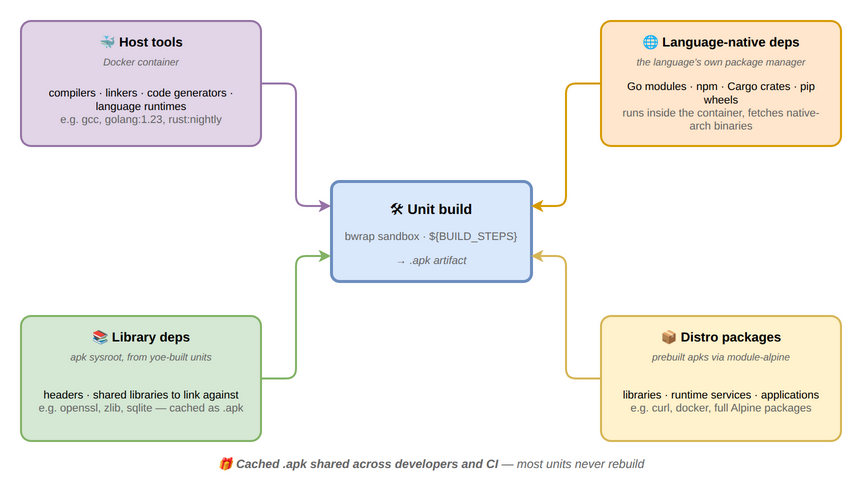
- Host tools (compilers, build utilities, code generators) — these come from
Docker containers. Every unit can specify its own container, so one team’s
toolchain requirements don’t constrain another. A kernel unit can use a
minimal C toolchain container. A Go application can use the official
golang:1.23image. A Rust service can pin a specific Rust nightly. - Library dependencies (headers, shared libraries your code links against) —
these come from a shared sysroot populated by packages (
.apkon Alpine targets,.debon Debian/Ubuntu targets). Each unit produces a package when it builds; that package is either built locally or pulled from a cache (team-level or global). Before a unit builds, its declared dependencies are installed from these packages into the sysroot — the same wayapt install libssl-devpopulates/usr/includeand/usr/libon a Debian system. Most developers never build OpenSSL themselves; they pull the cached package and get the headers and libraries they need in seconds. - Language-native dependencies (Go modules, npm packages, Cargo crates, pip
packages) — these are managed by the language’s own package manager, not the
sysroot. A Go unit runs
go buildand Go fetches its own modules. A Node unit runsnpm install. Cargo handles Rust crates. These ecosystems already solve dependency resolution, caching, and reproducibility —[yoe]doesn’t reimplement any of that. The container provides the language runtime (Go compiler, Node, rustc), and the language’s package manager handles the rest. When a language unit also needs a C library (e.g., a Rust crate linking against libssl via cgo or FFI), that C library comes from the sysroot as usual.
Caching is symmetric at the unit level. Every unit — regardless of language
— produces a package (.apk or .deb) that is cached and shared across
developers, CI, and build machines. Most people never rebuild a unit; they pull
the cached package.
The difference shows up when you do rebuild: a C unit finds its dependencies
already in the sysroot (from other units’ cached packages), while a Rust unit
has Cargo recompile its crate dependencies using its local cache. This is fine —
the person rebuilding a Rust unit is the developer actively working on it, and
their local Cargo cache handles repeat builds. Go builds so fast it does not
matter. Some ecosystems go further: PyPI distributes pre-compiled wheels
globally, so pip install pulls binaries for most packages without compiling
anything. [yoe] doesn’t need to replicate what these ecosystems already
provide.
Native builds unlock existing package ecosystems. This is especially clear
with Python. In traditional cross-compilation systems like Yocto or Buildroot,
PyPI wheels are useless — pip runs on the x86_64 host but the target is ARM, so
pre-compiled aarch64 wheels can’t be installed. Instead, every Python package
needs a custom recipe that cross-compiles C extensions against the target
sysroot, effectively reimplementing pip. In [yoe], pip runs inside a
native-arch container (real ARM64 or QEMU-emulated), so pip install numpy just
downloads the aarch64 wheel from PyPI and unpacks it — no compilation, no
custom recipe. The same advantage applies to any language ecosystem that
distributes pre-built binaries by architecture.
Note, there are risks with safety or mission-critical systems of using packages from a compromised global package system. We could force building of Python packages in some cases or verify the binaries via a hash mechanism. This point is for developers, we should be able to leverage all the conveniences modern language ecosystems provide.
Containers provide the tools to build. The sysroot provides C/C++ libraries
to link against. Language-native package managers handle everything else. For
any given unit, the developer, the system team, and CI all use the same
container — that’s how you stay in sync. A new developer clones the repo, runs
yoe build, and gets working build environments pulled automatically.
Docker containers are already the standard way teams manage development
environments. [yoe] leans into this rather than inventing a parallel universe
of SDKs.